

The receptionist walked me up to the top floor. Dan Wieden’s office sat above the rest of Wieden+Kennedy, glass from floor to ceiling on every side, with Portland spread out beyond it. He offered me a seat on the couch.
It was several months before the first Love Summit, and I had come to ask him for his building. I was working with John Perkins at Dream Change at the time, and I was living in Portland, where Wieden+Kennedy has its headquarters. John and Dan knew each other through the Pachamama Alliance, the sister organization John co-founded with Lynne and Bill Twist. When I started looking for a venue, John mentioned Dan. He was open to hosting, he said, but I would need to meet him first.
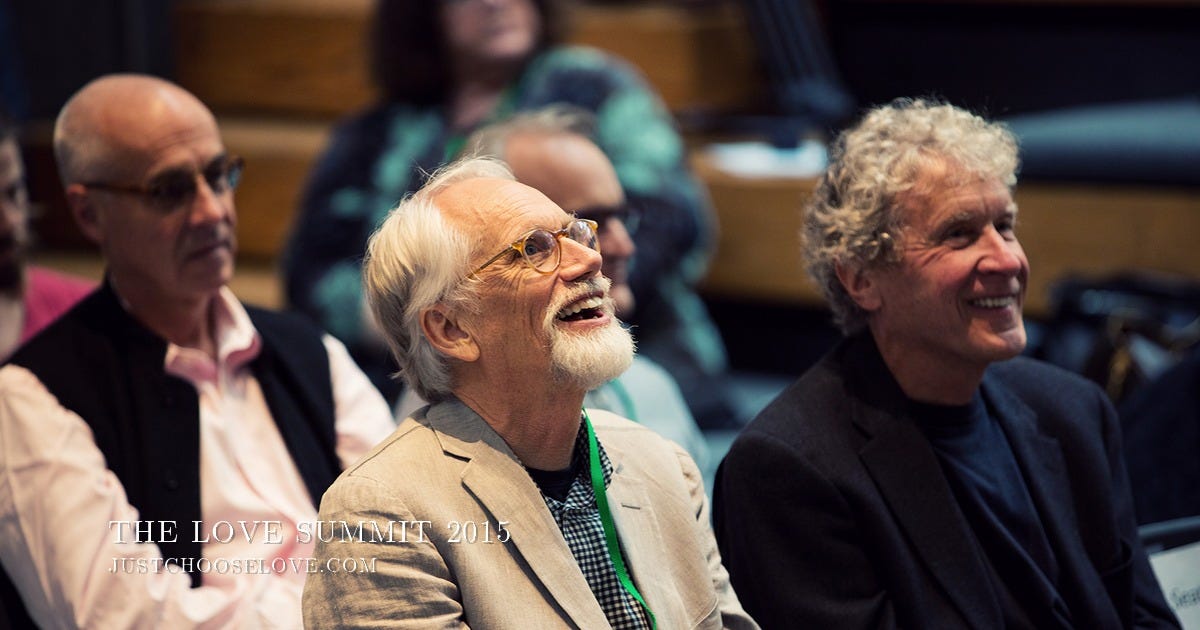
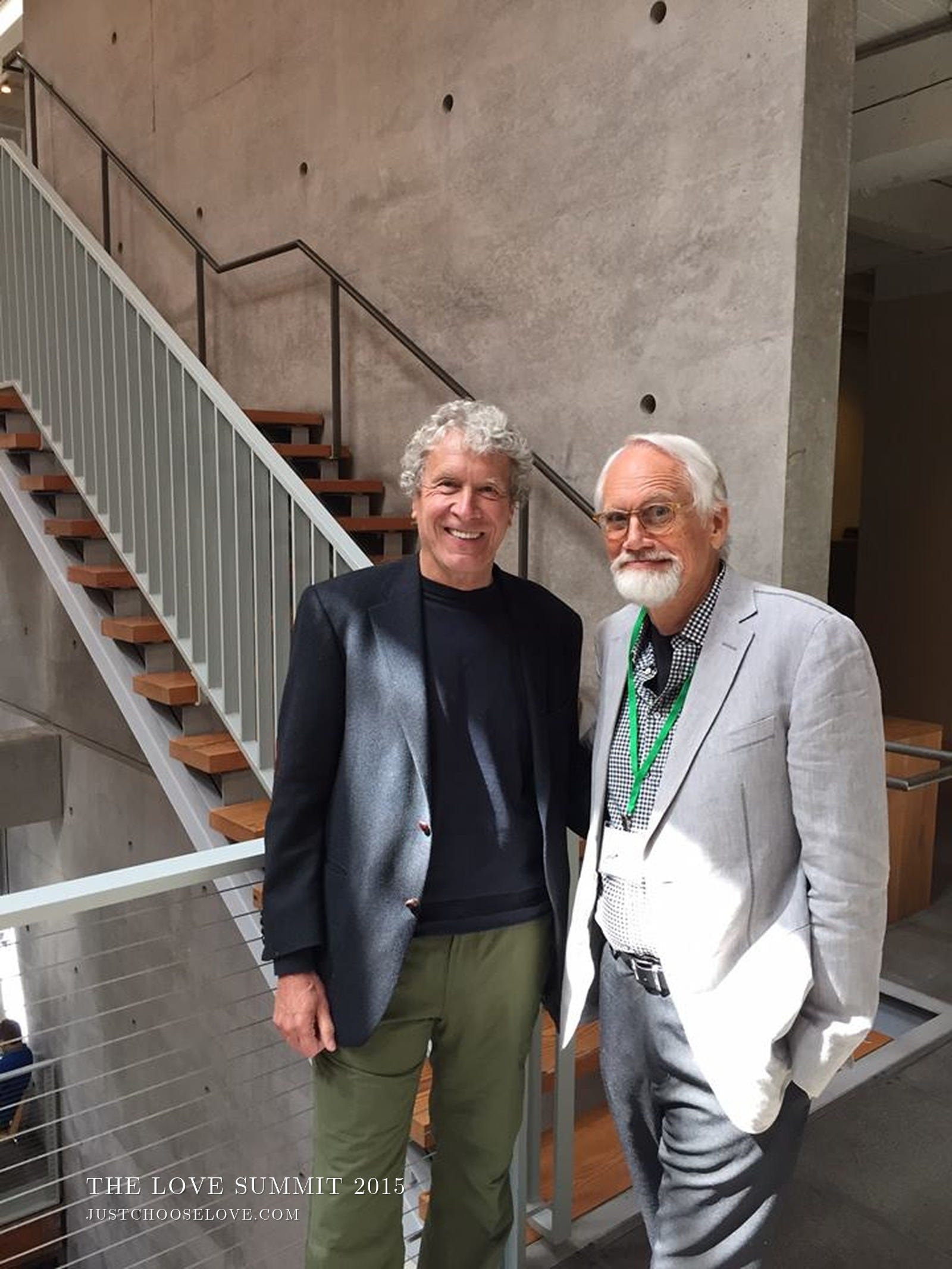
I was a little nervous. Dan had a full head of white hair swept back from his forehead, a neat white beard and round tortoiseshell glasses, and he was dressed nicely but casually, the way I’d see him again at the Summit, in a linen jacket over a checked shirt. Within a minute he had made me laugh. This was a man who took the things that matter very seriously and took himself much less so, and it showed in how quickly he put a stranger at ease.
Then he asked me to tell him about the Love Summit, and the nerves went. I’ve noticed this many times since. When I speak about something I believe in completely, the part of me that frets goes still. I can feel the difference between trying to persuade someone of something I’m uncertain about and talking about something I know, somewhere deeper than thought, that I’m here to do. That was what happened on Dan’s couch. I told him what I wanted the Summit to be, why I thought the word love mattered, and why I thought business needed a place where people could talk about the things that matter most to them without having to translate them into the language of strategy or performance.
Dan listened the whole way through. He was a wonderful listener, engaged and nodding, fully with me. When I finished, he told me he loved the idea, that he thought it mattered, and that much of what had made his own agency work was in it. Then he asked me one question.
“Are you sure you want to call it the Love Summit?”
He wondered what people in business would make of that word. He added a tongue-in-cheek line about the impression it might give, and we both laughed, because I knew what he meant.
I told him the name was the one thing I couldn’t move on. The word itself was part of the problem, I said, because we’re so shy of it at work. If love is as important to our lives and our businesses as I believe it is, perhaps the most important thing there is, then we need the courage to talk about it openly.
He accepted that. Wieden+Kennedy opened its headquarters to us, promoted the Summit to its own people, and made the ads for it. All of that happened because Dan believed in it, and because John was his friend.
Four years ago today
Dan died at his home in Portland on September 30, 2022. He was 77. His partner, David Kennedy, had died the October before, at 82.
The two of them opened Wieden+Kennedy on April 1, 1982, with one client, a running shoe company called Nike. In 1988, Dan wrote “Just Do It,” finding the words in an unlikely place: the last words of Gary Gilmore, a convicted murderer who faced a firing squad in Utah in 1977 and said, “Let’s do it.” Dan was struck that a person could meet that much uncertainty with those words, and he changed one of them. By the time he died, the agency had about 1,500 people in offices from Portland to São Paulo, Amsterdam and Shanghai, and was the largest independent agency in the world. He kept it that way on purpose, saying he would burn the place down before he sold it, and placing the agency in a trust so it would stay independent after him. He was inducted into his industry’s major halls of fame, and in 1996 he and his family founded Caldera, an arts and nature camp in Central Oregon for young people with few chances at either.
I wanted this piece to go out today because his talk that June is one of the clearest accounts I know of why love belongs inside an institution, from a man who spent forty years building one and had no interest in sounding soft about it. It’s the question the Love Summit keeps asking, of companies and of cities and governments too: what becomes possible when the people who hold power over other people’s days decide to practice love there.
The timing feels right in another way, too. The Pachamama Alliance, where Dan and John’s friendship began, turns thirty this year, and we’ll be at its anniversary celebration in New York this month.
The Like Summit
The night before the first day of the Summit, my mom and I were walking through Whole Foods after dinner when we came upon Dan and John in the café, eating ice cream. They were so happy and carefree, having the best time together on the night before the event. My mom had come to both Love Summits and has always been my biggest supporter, and she noticed the change in Dan right away: the man who had been a little hesitant about the name had become this one, open and lighthearted, sharing ice cream with his friend. I remember thinking about how quickly people can change when they feel welcomed into something, how the Love Summit seemed to have a way of doing that to people. They arrived a little guarded, and often before a single talk they were at ease and in joy with one another.
It was a family affair on both sides. Dan’s son Bryan and Bryan’s wife, Jessica, were part of Dream Change, Jessica on its board and Bryan as an advisor, and both served on our Love Summit committee. They became dear friends of mine. Jessica was one of my closest friends, first on Bainbridge Island, where I’d moved to work for Dream Change, and then in Portland, and for a while, between homes, I lived with the two of them in the house they had just built.
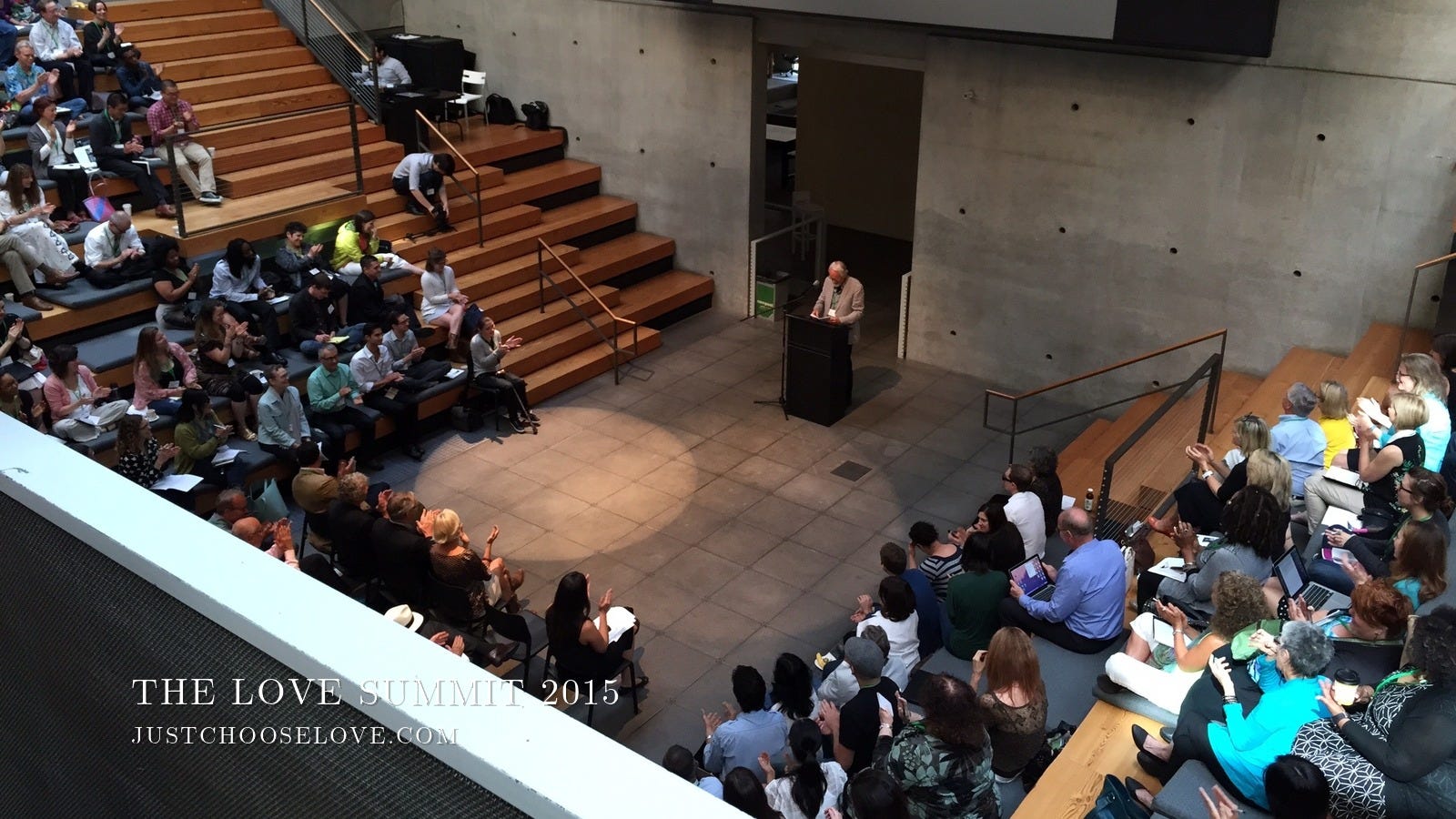
The next morning, June 13, 2015, leaders from a range of industries filled Wieden+Kennedy’s headquarters. After John and I welcomed everyone, Portland’s mayor, Charlie Hales, spoke about Alexis de Tocqueville’s phrase “habits of the heart,” and told us Portland had learned a few of them. Then he handed the room to Dan.
Dan welcomed us, said he had sat through too many business conferences mining “the same damn vein of gold” that had been stripped away long ago, and told us this one had the potential to be different. Then he got to the word.
“I’m trying to put off coming up to a four-letter word here. Love. To be totally honest, it makes me wince a bit, this love thing.”
He had no trouble, he said, telling his wife he loved her, or his family, “living and dead,” or his cat and his dog. The canary was another matter, at least when it started singing at 5:30 in the morning. He liked the canary. “I was actually thinking maybe it might be more comfortable if we all call this morning’s event the Like Summit,” he said. “But she wouldn’t let me get away with that.”
She was me. It was the same conversation we’d had on his couch, and he told it on himself, in his own building, to a room full of people he had welcomed in. Then he spent the rest of his time making the case for the word he had winced at.
Walk in stupid
He started with how little they’d had. He and Kennedy put in about $500 each. They set up in the basement of an old labor temple and couldn’t afford a phone, so they ran down the hall to use the public one. Their one client, Nike, spent $1.2 million on advertising in total, and Phil Knight told Dan at their first meeting that he didn’t believe in advertising.
“It was really, really important to be stupid and with no money,” Dan said. Knight didn’t believe in advertising and they didn’t know much about it, and Dan called what grew out of that gap the power of ignorance. It became a saying in every one of the agency’s offices: walk in stupid every morning. “Because somewhere between last night and this morning, something is different than it was,” he told us. “You better find out what it was, and don’t feel so cocky because you knew yesterday.”
The only people they could afford to hire had been fired from other agencies or were kids straight out of school. They called themselves the ship of fools. They tried things and failed and tried other things, and Nike shoes started flying off the shelves.
It’s the culture, stupid
Then the big agencies noticed. They came in with bigger salaries and started taking Wieden+Kennedy’s people, and Dan and Kennedy discovered they could grow talent but couldn’t keep it. They wrung their hands over it, he said, day and night, asking what trumps money.
“It’s the culture, stupid.”
So they built a culture “so wild, so right-brained, so aching to overthrow traditional advertising principles” that people thought twice before heading for the exits. The bigger the agency grew, the more it depended on that culture to hold together.
He told us what he told everyone who joined: “If you’ve come to work at Wieden+Kennedy, you’ve come here to fail harder than you ever have before,” because failure is often “where the magic lurks.” And while you were there, it was your job “to explore every inch of your personality, to find out what a complex, contradictory human being you truly are, and what astonishing people you’re working with, shoulder to shoulder, synapse to synapse.” The work demanded very different people, under pressure, who could bond with people unlike themselves. “The stronger those bonds between people,” he said, “the healthier Wieden+Kennedy.”
That’s as good a description of love at work as I’ve heard, and he gave it to us before he had once said the word.
More hate than love
Dan didn’t ask us to take his word for it. Before the Summit, he had people around the agency asked one question on camera: does love have anything to do with this culture? Then he played their answers, unvarnished, to a room that had come for a Love Summit.
“Do you know anybody that loves advertising?” one of them asked. “When I meet someone who says they love advertising, I think I hate them.” Another said love “feels really squishy,” and that the place “has a much harder edge than that.” Another said, simply, “I think there’s more hate than love here,” and the room laughed.
And in between those came the others. “I think I just told Jason five minutes ago that I love him.” “I care deeply about every person in that building.” Someone else began, “the relationships you make while you work here,” then stopped: “I was about to say while you live here.” Those relationships, they said, were unlike anything they had encountered in their life.
He let his own people argue with the premise, on his stage, and it made what he said next easy to believe.
“For all our business success, which honestly seems inexplicable, it has had little to do with hardcore business practices. I think our success is because of all that soft stuff. That affection for one another. That deep understanding of what we need from one another, and what they need from us.”
“It just ain’t the money,” he said. “It just ain’t fame. It’s all those years we’ve spent loving one another. To be really honest, that’s been the big payoff.”
It’s not about what it’s about
He ended on a story. Some years earlier, the agency had opened a school inside its building to look for new ways of teaching creativity, led by Jelly Helm, a teacher and one of its creative directors. Helm gathered twelve “exceedingly odd and wonderful young people.” A week or two in, one of them came to him and said the school was great, but what was this Wieden+Kennedy thing all about?
Helm smiled. “When it comes to Wieden+Kennedy,” he said, “it’s not about what it’s about.”
“Jelly left it there,” Dan said. “I will too.” And he thanked us and sat down.
I understand that line better now than I did in 2015. The ads were what the agency made, and they were very good. But I think about the people making them, the ones who had been fired elsewhere, the kids who didn’t know any better, the very different people who learned under pressure what they meant to each other, and I think that was what Dan had sensed months earlier in his office when he told me how much of what made his agency work was in the idea.
My mom watched the rest of it happen over those two days, from his hesitation about the name, to the ice cream with John, to the man on stage who embraced everything the Summit was about. I wonder whether writing the talk was part of what helped him see that love was what Wieden+Kennedy had been about all along. He had held it together for forty years with an affection he was a little embarrassed to name, and that morning he named it in front of all of us.
So here is the question I’d ask you, on the day we remember him:
Who do you work beside, shoulder to shoulder, who is nothing like you? What might change for them, and for everything the two of you make together, if they knew what they meant to you?
Thank you, Dan.
Watch the talk: Mayor Hales & Dan Wieden: What’s Love Got to Do With It? | Love Summit 2015
Earlier in this series: The Secretary of Good Living · Power and Love · Close Enough to Love · Ask What They Love · The Words We Carry · Love With a Vengeance · Hang On Mandela
The Love Summit returns in 2027, and we’re building a year-round community around it. It brings together people from business, government, and civil society to explore one question: what becomes possible when love and power work together, and love is a practical way of leading, building organizations, and governing? If you want to be part of it, or you know someone who belongs in these conversations, email me directly: Samantha@justchooselove.com
About Dan Wieden. Dan Wieden (1945-2022) was born in Portland, Oregon, and studied journalism at the University of Oregon. He co-founded Wieden+Kennedy with David Kennedy in 1982 and wrote Nike’s “Just Do It” in 1988. Under his leadership, the agency became the largest independent advertising network in the world, with clients including Nike, Coca-Cola, Old Spice and ESPN, and he placed it in a trust to keep it independent. He was inducted into the One Club, Art Directors Club and American Advertising Federation halls of fame, received the Cannes Lions’ Lion of St. Mark in 2012, and founded Caldera with his family in 1996. He hosted the first Love Summit at Wieden+Kennedy’s Portland headquarters in June 2015.
A note on how this was made: I worked with Claude to organize the transcript, check the research, and draft this piece. The judgment about what to keep is mine. I include this note because I’d rather you know how a piece was built than wonder. There’s more on how Love Summit essays are made on my About page.