
Power and Love
A Turkish entrepreneur believed love and power were opposites, until his doctoral thesis was sent back for leaving power out. Second in a series from the Love Summit archives.

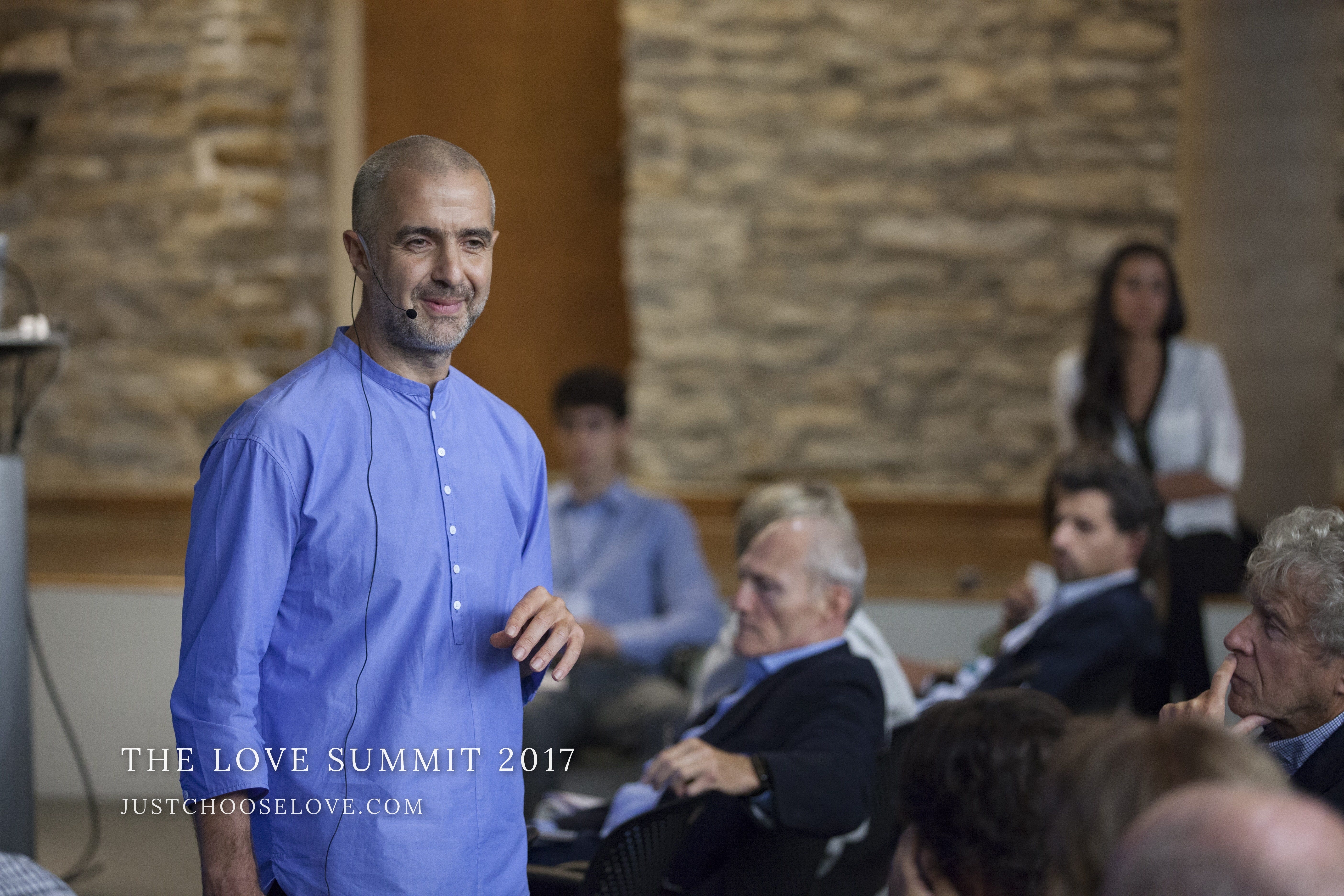
The weekend before he stood up to speak, he’d been at a school reunion, back among friends he’d known thirty years earlier. They asked what had brought him to town. A reunion, he said, but also a summit. What summit? He hesitated. A love summit. And then he watched the reactions move across their faces. Some leaned in, curious. Some laughed, the heavy kind of laugh. Some said nothing at all. He found himself rushing to explain. I’m in business, he’d say, this is about loving business. But the more he explained, the deeper the discomfort went, in them and in him. That awkwardness, the difficulty of holding love and business in the same sentence without apologizing for it, turned out to be his whole subject.
This was 2017, at the second Love Summit, in Cincinnati. Alper Utku had come up through business, built companies, and describes himself, without irony, as a student of love. Before he told his own story, he asked the room to name the challenge that had brought them there. People did. Too much fear of failure, one said, the fear of trying something new like this and having it not work. Too much noise, said another, and the trouble of finding your own voice inside it. And then, from somewhere in the room, the one that landed closest: it isn’t professional. Love, in business, in quotation marks. Exactly, he said. That was the challenge he’d spent his life inside.
The two drives
For a long time, he had no way to hold the two together. What finally gave him one was a book by Adam Kahane, Power and Love, written out of Kahane’s years facilitating the work that helped South Africa’s transition out of apartheid. Kahane borrows a pair of definitions from the theologian Paul Tillich. Power is the drive to achieve one’s purpose, to make things happen. It’s the engine of any business. Love is the drive to unite what has been separated, the energy that connects things that seem to stand apart. Set side by side, they look like opposites. Getting things done, and drawing things together. But the argument Alper took from the book, and then spent years testing on his own life, is that they aren’t opposites at all, and that most of our trouble comes from treating them as if they were.
He put it in Martin Luther King’s words, from a speech King gave in 1967. Power without love is reckless and abusive, and love without power is sentimental and anemic.1 You can feel both failures without much effort. Power without love is the team that hits every deadline and trusts no one. Love without power, King said, is the affection that never becomes anything, the good intention that can’t act. Alper’s story is the story of a man who spent the first half of his life at one pole and then overcorrected all the way to the other, and only slowly found the place between them.
The first encounter with power
He was born in Turkey, into a country he describes as still not knowing what to do with power, after centuries in which power belonged to sultans and only recently to everyone. His first encounter with it was his father, an army physician, a man of rank and authority whom the young Alper found rigid, sometimes oppressive, hard to reach. He decided early that power and connection didn’t go together. So he found another way to be close to it. He became successful. He worked hard, rose to the top of his class, learned that achievement could win him attention and affection and a way through conflict. It worked for years.
The prayer on the calendar
Then, at seventeen, he came to Cincinnati as an exchange student, the same city that would host the second Love Summit some thirty years later, and the year changed him more than he knew at the time. He stayed with a family, George and Rose, whom he still calls mom and dad. George was an economist of real standing, head of the university’s economics center, sought out by governments, and also warm, funny, easy to be around. The idea Alper had carried since childhood, that power and warmth couldn’t live in the same person, started to unravel.
The part he’d never told anyone happened one early morning in that house. He was alone in the kitchen, planning his week, and he reached for what he thought was the family calendar. It fell open to something more like a diary. He knew he shouldn’t read it but couldn’t stop himself. It was dated the week before he arrived, before Rose had met him, and it was a prayer. She had asked God for the courage and the power to give this boy the love he was going to need. He hadn’t earned it by being anyone. It was waiting for him before he came. That was the first time he understood that love could be unconditional, that he didn’t have to be successful to deserve it.
The thesis that was refused
The lesson didn’t take right away. He built his first businesses on the only model he trusted, power without love, and it cost him. His health, his relationships. At some point, after a hard stretch he says was physically breaking him, he decided to change, and he began bringing what he then just called connection and engagement into his company. They worked with a psychotherapist across the whole organization for three years. They named love as a company value and left it on the website. The results were real enough to become a case study, to win a workplace award in Europe, to carry the firm onto the stock exchange. And he enrolled in a doctorate to make sense of all of it. He called the thesis leading with the heart.
In 2013 it was refused. Sent back for a thorough revision, three hundred pages, the kind of verdict that stings more when you’re proud of the work. What the examiners told him is the hinge of the whole talk. The thesis was missing him. It said nothing about how he related to power, how he used it. He seemed to be discounting it entirely. His first reaction was to get angry. These Anglo-Saxons, he thought, are infatuated with power; I’ve moved past all that. But he remembered a friend once telling him, gently, that people were a little afraid of him, and he hadn’t been able to understand why. Slowly it came together. In fleeing power without love, he had run all the way to love without power, and gone blind to the power he still carried. He had done the same thing he’d always done, split the two apart, only this time he’d landed on the other side.
Tilt toward love
What brought him back was ordinary, practical work. Advising a board, he kept trying to steer them toward coaching, listening, the inner tools he’d come to love. They were patient with him. These are wonderful, they’d say, but we have things to do, can you help us do them. It took him a while to stop resisting and hear it. You have to build a base of power before you can talk about love. That’s how the world works, at least where he lives. King, again, had said the same thing from the other direction: love makes power generative, and power makes love generative. You need both. And from his Sufi teachers he took the tiebreaker, the rule for when the two come out even. When they’re equal, tilt toward love. We always have that choice, and the choice is what matters.
He built a university out of it, called European Leadership University when he gave this talk and Amsterdam Tech today. In his part of the world, he explains, the simplest form of power a young person can hold is a degree and a job, the status you need for almost everything, including, he jokes, marriage, since asking for someone’s hand means surviving an interview with her father that begins the moment you set down the chocolates. So Amsterdam Tech gives young people that base first, real, accredited, job-ready degrees in digital skills, with work alongside the study. And then, in return, it asks something of them. They contract to do the personal work too, so that they don’t graduate as only engineers but as what he calls human engineers. Power as the foundation. Love as the aim.
The work of congruence
I keep returning to what the examiners told Alper, because it’s close to what I’ve seen in my work with leaders. The difficulty is almost never a shortage of good values. Most of the leaders I’ve worked with can tell you exactly what they believe. The difficulty is the split Alper is describing: the leader who runs on power and loses the connection, or the one who has all the warmth in the world and won’t go near power, so nothing they care about ever gets built. The work is congruence, holding both drives at once without amputating either, being the same person in the boardroom that you are at home. It rarely announces itself. It happens in ordinary decisions, the small ones that we often only recognize as turning points in hindsight.
The thread to now
The question Alper was answering in that room is the one we’ve built the next Love Summit around. How do we practice love inside structures of power, not as a private feeling we carry home, but as something that shapes how organizations are run and how power gets used. He was answering it in 2017 with his own life, and he’s answering it again now, as one of the small group advising the next Summit. That continuity, from a talk in an auditorium to the work of rebuilding, is a good part of why I wanted to go back to this one.
There’s one more detail I love. He spoke that afternoon right after Nathan Hendricks, who had just finished telling the room that capitalism is a religion. So Alper closed with a religion of his own, a poem from the thirteenth-century mystic Ibn Arabi:
My heart has become capable of every form: a pasture for gazelles, a cloister for monks, a temple for idols, the pilgrim’s Kaaba, the tablets of the Torah, the book of the Quran. I follow the religion of love, whatever road love’s caravan takes. That is my religion and my faith.
A religion of love, grounded in power as strength, not domination, is one worth carrying forward.
You can watch Alper Utku’s full talk from the second Love Summit here. It runs about twenty-three minutes. Excerpts above are lightly edited from the transcript.
This is the second in a series from the Love Summit archives. The first, on Freddy Ehlers, is here.
We’re building the next Love Summit now, a small group of us, and we’re looking for a few more: speakers, partners, and people whose work already lives inside this question. If that’s you, write to me directly at samantha@justchooselove.com.
About Alper Utku
Alper Utku is founding partner and executive chairman of Management Centre Türkiye, one of the region’s leading management consultancies, and the founder and president of Amsterdam Tech, formerly European Leadership University, a skills-based institution that pairs accredited degrees with real work for students building careers in the digital economy. He trained as a mechanical engineer at Boğaziçi University and later took a doctorate in organizational consultancy at Ashridge and Middlesex University. He co-authored the Turkish bestseller Agile Companies, has crossed the Atlantic by sailboat, and is one of the people advising the next Love Summit.
A note on how this was made: I used Claude to help organize the material, check the history, and shape this draft. The words are mine and Alper’s, drawn from the transcript of his talk. I include this note because I’d rather you know how a piece was built than wonder.
From “Where Do We Go From Here?”, Martin Luther King Jr.’s 1967 address. The fuller line continues: “Power at its best is love implementing the demands of justice, and justice at its best is power correcting everything that stands against love.”