

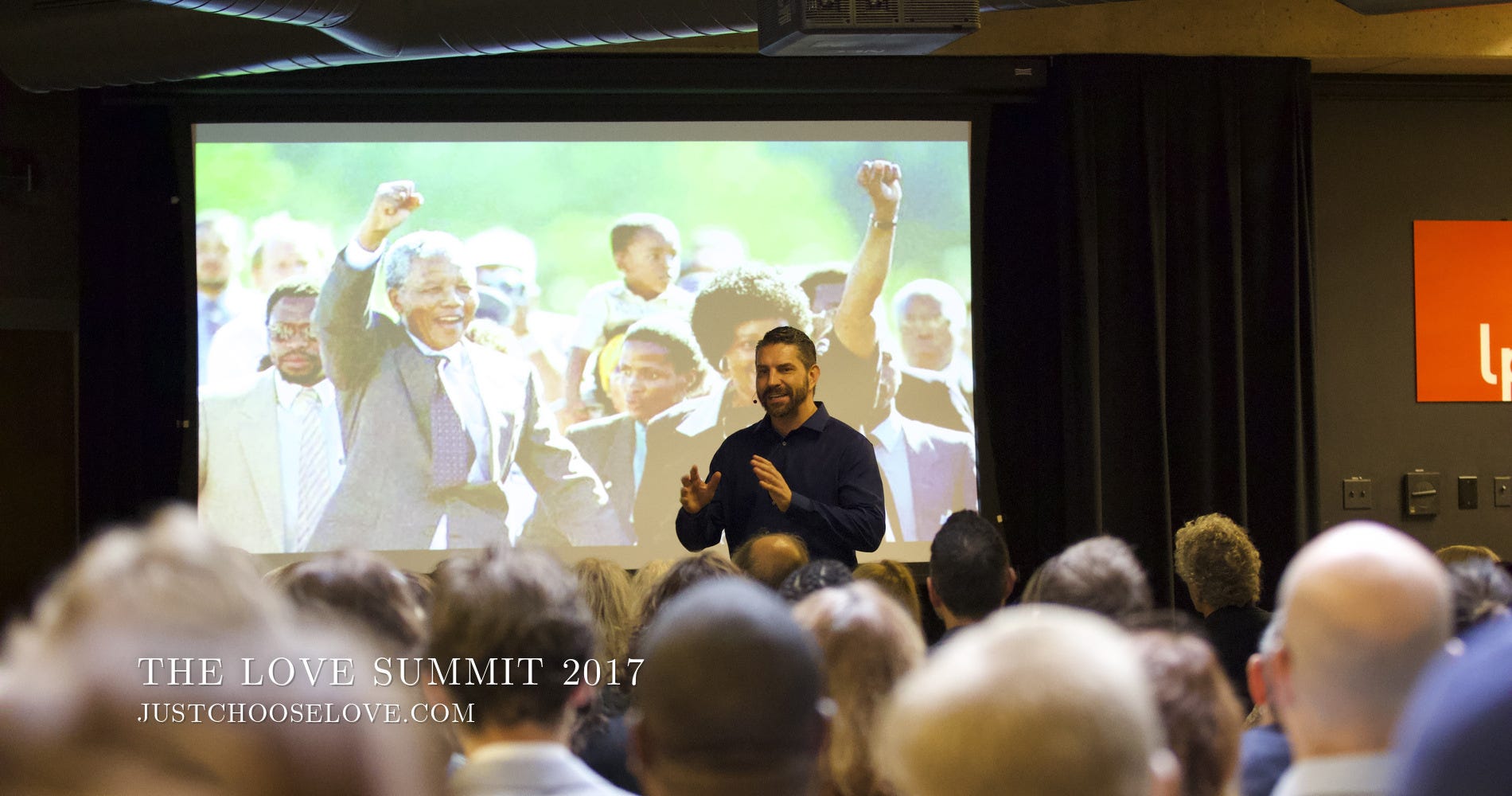
Seventh in a series from the Love Summit archives.
Someone painted HANG MANDELA on a wall beside a road outside Johannesburg, and Andrew Sykes read it for the first time from the back seat of his father’s car. He asked who Mandela was. He doesn’t remember the answer, because what he was thinking about was space travel.
Months later, someone had added two letters, and it read HANG ON MANDELA. He smiled at that and went back to daydreaming, this time about falling in love.
He was about twelve the last time he saw it, and a third hand had been at work: HANG ONLY MANDELA. Andrew told this story from the stage at the Love Summit in 2017, and said the first writer had won.
He went back to daydreaming after that one too. He was twelve, and it was a wall.
Three people wrote on that wall, and every one of them was arguing about whether a man should be killed. Two of the three thought he should.
That argument, at the scale of a country, is the question beneath nine years of the Love Summit: what becomes possible when love shapes how we lead, how we build, and how we hold power. It’s a practical question, and it comes down to whether love holds when you hand it the work a policy is supposed to do. South Africa handed it that work.
Twenty miles, and fifteen years
On June 16, 1976, twenty miles from that wall, the students of Soweto walked out. The government had decreed that half their lessons be taught in Afrikaans, the language of the state that governed them and one that many of them couldn’t follow, and teachers who struck over it had been dismissed. Thousands of children set off to march that morning.
Outside one school, about thirty of them were getting ready to join the others when the police arrived to stop them. The children threw stones. The police answered with tear gas. Then they opened fire, and Hector Pieterson, who was twelve, went down.
When the gas cleared, his sister Antoinette heard him crying and went looking for him. She was seventeen. An eighteen-year-old named Mbuyisa Makhubo reached her brother first, picked him up and carried him toward the nearest car, and a photographer called Sam Nzima took one frame of that walk. Hector was pronounced dead at a clinic, and his mother was told the next day.1
Nzima’s photograph ran on front pages around the world, and a government that had been willing to shoot children discovered it was not willing to be seen doing it.
Andrew says the news took fifteen weeks to reach Nelson Mandela, fourteen years into his sentence on Robben Island, and that when it arrived it told him the fight had not ended with his own generation.
It took fifteen years to reach Andrew, who was twenty miles away, twelve years old, and wondering whether he would fall in love. He has spent a good deal of his life since thinking about what he didn’t know, and how long he didn’t know it.
A country that made itself say it
Mandela came out after twenty-seven years and went straight into negotiating away the system that had jailed him, through bombings and assassinations and massacres meant to stop him. The night before the election, a car bomb killed nine people, and he asked the country for calm. When another went off, he asked again.
On April 27, 1994, close to twenty million people lined up to vote, most for the first time in their lives and some for fourteen hours. Everyone Andrew knew had expected a civil war, and so had most historians.
Winning the election healed nothing, and Mandela understood that better than the people celebrating. He set up the Truth and Reconciliation Commission, asked Desmond Tutu to chair it, and for three years its commissioners sat in church halls and school rooms while more than twenty thousand people said what had been done to them and to the people they loved.
The commission hired professional comforters. A government invented that job and paid for it because it knew what it was asking of the people who would have to speak, and of the ones who would have to listen.
What made the commission different from the others was the offer it made to the people who had done the killing. Tell the whole truth, admit the crime, show that it was politically ordered, and you could ask for amnesty.
Eugene de Kock took that offer. He had commanded a police unit responsible for kidnapping, torture and the deaths of more than a hundred people, and his own colleagues called him Prime Evil.
Pumla Gobodo-Madikizela, a psychologist working for the commission, sat with him for hours. At one point, watching him come apart, she reached across and touched his hand.
He told her afterwards that she had touched his trigger hand.
She has never called it forgiveness. What she describes, in a book about whether she should have done it at all, is closer to a reflex she then spent years trying to understand.2
Her hand moved before she had decided anything, and that is the part of love I trust most: the reach that comes before a person has worked out what the other one deserves.
What his mother did the next morning
In 1980, Andrew’s older brother William spent a day go-kart racing with friends at an abandoned drive-in. Their youngest sister Leanne, the quietest of the eight of them, asked at the end of the day if she could have a turn. William put her in the kart, put a helmet on her head, gave her some instructions, and turned back to packing up.
She came down the first straight into a hard right-hand turn and put her foot on the accelerator by mistake. William turned around to see the kart going through the air. He ran, expecting to find her bruised. Her helmet had come off, and she had gone under a wire fence, and he picked her up and carried her to the closest car.
She was in surgery for twelve hours. She was fifteen.
Andrew was small, and his mother kept him away from most of it. Through a window that night he watched his brother come home and take off his clothes, one piece bloodier than the last, sobbing. Years later William told him why. He couldn’t remember whether he had fastened the helmet.
Their mother went to him and comforted him. That is the picture Andrew has carried since, and the one his whole talk is built around.
Then she went back to the hospital. At six the next morning, Andrew heard her voice in the kitchen and smelled the same breakfast she cooked every other day, and she sent all of them to school as though it were an ordinary day.
Leanne came home nine months later and learned to swallow again, then to chew, then to talk, and eventually to smile.
When she went back to school at fifteen with a changed face, children who didn’t know better asked their mothers what had happened to that girl, and teenage boys who should have known better said things that did more damage. So their mother took all eight of her children away on the first family vacation they had ever had, mostly to give Leanne somewhere else to be.
Andrew knows the clinical details of his sister’s recovery because he read them in a case study published twenty-two years after the accident.
The second author of that paper was Professor Leanne Sykes, who went back to work in the department where she had spent those years as a patient, and now runs it.3
Five things a mother taught a company
Their mother died of pancreatic cancer fifteen years later, and her eight children stood in the rain at her funeral wondering who would hold them together now. Andrew’s answer, worked out since, is that she had already taught them how.
He puts it as five habits, and every one of them is something she did rather than something she said:
When things go wrong, gather people closer rather than letting them go.
When someone makes a mistake, comfort them rather than reprimanding them.
When someone is hurt, in the body or otherwise, give them time.
When they need it, give them the privacy to find their own strength.
Celebrate, and mean it.
Most organizations get the second one backwards, on the theory that a reprimand prevents the next mistake. Andrew’s mother had a son standing in a doorway in bloody clothes who couldn’t remember whether he had fastened a helmet, and she knew the reprimand was already running inside him at full volume.
What he needed that night was his mother.
The beer he shouldn’t have ordered
In 2007, Andrew went to a seminar in Chicago on integrity, at the suggestion of a woman he was seeing who thought he could use some. He arrived certain that he had no relationship with his father and was fine about it. They had not had a civil conversation in twenty-five years.
On the second day, having agreed twice that morning to a rule about no alcohol, he ordered a beer at lunch because rules didn’t apply to him. The woman across the table mumbled something. He leaned back and asked her to say it again, and she looked up and told him he had no integrity.
He sat there angry because he had no answer, and then found that beneath the anger was embarrassment, and beneath that was the fact that she was right. He sent the beer back and apologized to her.
Two years later, he married her.
What he worked out that week was that the reason he had no relationship with his father was a story he had been telling himself about what his father had done and not done, a story in which he was the one it had happened to. He also worked out that before he could become a father, he would have to learn how to be a son.
So that night he called South Africa, which meant waking his father at six in the morning, and rambled at him until his father asked what he was trying to say. So he said it. He said he loved him, and that he hoped they could have a relationship.
His father was quiet for what felt like three days and was probably thirty seconds, and then said, “Andrew, it’s all I’ve ever wanted.”
Twenty-five years of silence, and the man had been waiting through every one of them for that sentence.
They had five years.
His father’s health was already failing when he came to Chicago for the wedding. When the cancer turned, the hospice nurse thought he was holding on for one more call and held the phone to his ear, and Andrew thanked him for the example he had given him and told him it was time to let go.
Then the phone died.
He climbed a mountain in southern Colorado the next day and wrote his father’s name in the book at the summit, with the date and the time. Coming back down, his phone found signal, and a message with it.
His father had died at three on Sunday afternoon.
Twenty-five years, and thirty seconds
Andrew named his Love Summit talk ‘Addicted to Love’. He ends it by saying he isn’t interested in whether you’re addicted to the feeling of being in love, and asking instead whether you can practice the habits of it at work, “when doing nothing at all seems easier.” He wrote those closing lines himself, in answer to the poem he threads through the whole talk, Oriah Mountain Dreamer’s ‘The Invitation’.4
He built his talk so the scale keeps shrinking, from a country to a family to one man at a lunch table with a beer he shouldn’t have ordered, and the same thing is happening the whole way down. People saying the true thing first, before they know what it will do.
Twenty thousand South Africans said theirs to a commission. A psychologist put her hand across a table toward a man she had every reason to hate. A mother went to the son who might have failed to fasten the helmet. A man woke his father at six in the morning.
South Africa did not become the country it hoped for in 1994, and everyone who stood in line for fourteen hours that April knows it. What it proved is something smaller, and much harder to argue with: in the year when the whole thing could have gone the other way, enough people chose this, and the war that history had all but promised never arrived.
Flying toward a country that had to answer its own version of the same question sent me looking into a piece of Australian history I had never heard.
In the Australian winter of 1971, the South African rugby team toured there, a whites-only side sent by a whites-only state, and at nearly every ground they were met by people who didn’t want the games played. Queensland declared a state of emergency. By the time the tour ended in August, the South African cricket tour meant to follow had been called off, and the government that came in that year refused sporting visas to any team selected by race.
Before those ten weeks, about seven Australians in a hundred thought their country should stop playing sports with South Africa. By the end, more than a third did. Nothing inside South Africa had changed. What changed was that a great many Australians had to say where they stood, in front of their neighbors, and saying it changed them.5
We go on to Tasmania after Sydney. In 1997, the Tasmanian parliament apologized to the Aboriginal families whose children the state had taken, and nine years later it became the first Australian state to pay them, five million dollars under an act of its own parliament. A hundred and six people received a payment. Forty-five applications were refused.6
You need both numbers. An apology, a commission, a fund: none of them arrives whole, and every one of them is argued about afterwards by the people it was meant for.
None of them were enough, and every one of them was worth doing.
Here is the part that encourages me.
A country needs a commission, a fund, a decade, and a great many people willing to say what happened to them. A person needs a phone call at six in the morning and thirty seconds of quiet on the other end.
That is the whole of it, and it is already in your hands. Whatever you haven’t said is almost certainly lighter than it looks from here.
Andrew got five years with his father. His father got to hear his son say he loved him.
Thank you for being here.
Watch the talk: Andrew Sykes, “Addicted to Love: Create and Feed the Ultimate Habit,” Love Summit 2017
Earlier in this series: The Secretary of Good Living · Power and Love · Close Enough to Love · Ask What They Love · The Words We Carry · Love With a Vengeance
The Love Summit returns in 2027, and we’re building a year-round community around it. It brings together people from business, government, and civil society to explore one question: what becomes possible when love and power work together, and love is a practical way of leading, building organizations, and governing? If you want to be part of it, or you know someone who belongs in these conversations, email me directly: Samantha@justchooselove.com
About Andrew Sykes. Andrew is the founder and chief executive of Habits at Work in Chicago. He lectures in entrepreneurship at Northwestern’s Kellogg School of Management, where Inc. ranked his course on entrepreneurial selling among the ten best in the country. He began his working life in South Africa and built one of its largest healthcare consulting firms before moving to the United States. His research comes out of the Behavioral Research and Applied Technology Laboratory and asks which habits hold up over time in the places people work. It became a book, ‘The 11th Habit’, and the training his company does with Google, Pinterest, eBay and Subaru. On his website he describes himself in three words: professor, speaker, poet.
A note on how this was made: I worked with Claude to organize the transcript, check the research, and draft this piece. The judgment about what to keep is mine. I include this note because I’d rather you know how a piece was built than wonder. There’s more on how Love Summit essays are made on my About page.
Soweto, June 16, 1976. The Afrikaans Medium Decree was issued in 1974 and enforced from 1976, so it predates the march rather than arriving with it. The government first admitted twenty-three deaths; the Cillie Commission counted 575 by February 1977. South Africa’s population in 1976 was about twenty-six million, and Soweto’s was in the hundreds of thousands.
The commission, and the two people in that room. The TRC was established in 1995 under Desmond Tutu, and about twenty-one thousand people gave statements. Eugene de Kock commanded the C10 unit at Vlakplaas, was sentenced in 1996 to two life terms plus 212 years, and was paroled in 2015. Pumla Gobodo-Madikizela’s account of their interviews is A Human Being Died That Night (2003).
Leanne Sykes. Professor Leanne Sykes heads the prosthodontics department at the University of Pretoria, and has written about the accident that left her, in her own words, a dental cripple.
The Invitation. Oriah Mountain Dreamer wrote the poem in 1994, and Andrew returns to it four times across the talk. It’s in copyright and isn’t quoted here, but it’s easy to find and worth the three minutes.
The 1971 Springbok tour of Australia. The tour ran from June to August, and Queensland declared a state of emergency during the protests. The opinion figures come from the Commons Social Change Library’s account of the campaign.
Tasmania. The apology came in 1997, and the Stolen Generations of Aboriginal Children Act 2006 made Tasmania the first Australian state to pay compensation, from a five million dollar fund.